Learning Management Software for Universities: 9 Essential Features to Look For
By Sonet Microsystems
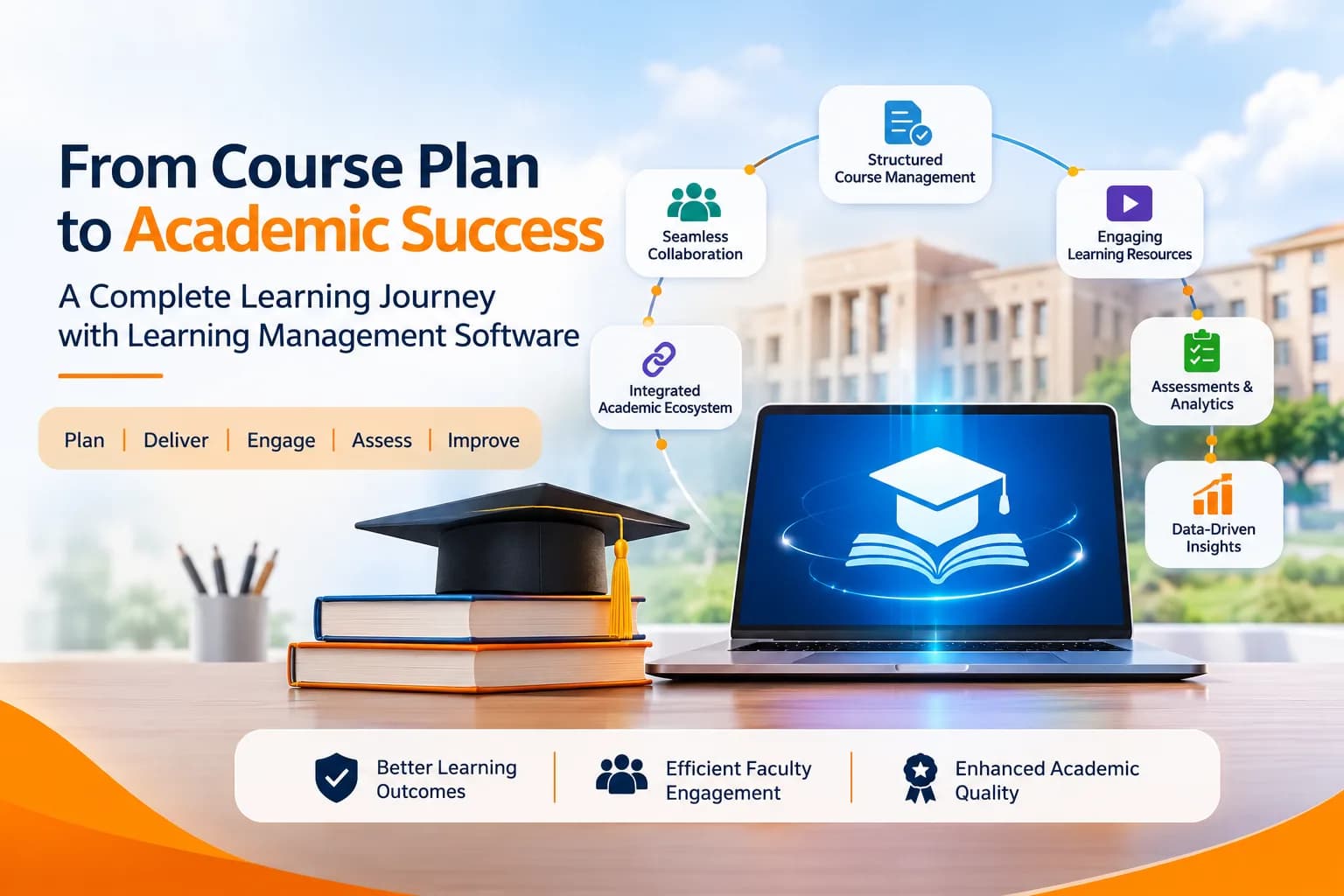
A university course does not begin when a faculty member uploads a PDF, and it does not end when students submit their final assignments. Between those two moments lies an entire academic process: defining learning outcomes, organising the syllabus, developing teaching material, facilitating discussions, evaluating understanding and determining whether the intended learning has actually taken place.
Yet these activities are often distributed across different tools, departments and academic workflows.
This is where learning management software needs a more meaningful role in higher education. It should not simply provide a digital location for lectures and assignments. It should connect the complete academic journey of a course, making teaching activities, learner participation and assessment outcomes part of one structured learning environment.
For universities and higher educational institutions, the opportunity is to move from managing digital content to managing the architecture of learning itself.
1. Start with the Course, Not the Content Library
One of the most important decisions in digital learning is how a course is structured before students begin accessing it.
A course has a defined syllabus, academic calendar, learning objectives, instructional material and assessment requirements. If these elements are not organised from the beginning, faculty members may end up managing individual activities without a clear view of how they contribute to the overall academic plan.
A well-designed learning management system should allow institutions to organise courses around subjects, modules, topics and academic schedules. Faculty should be able to plan content, assign learning activities and monitor syllabus coverage as the semester progresses.
This is particularly important for universities following CBCS, NEP-aligned academic structures and multidisciplinary programmes, where course combinations and learning pathways can vary across departments.
Sonet's Knowledge Setu supports structured course and syllabus management, with academic calendar alignment and syllabus coverage tracking. This helps institutions establish a more organised relationship between what is planned, what is delivered and what students are expected to learn.
2. Turn Faculty Expertise into Reusable Academic Resources
Universities generate a substantial amount of academic knowledge through their faculty members. Lectures, presentations, research material, reading lists, case studies and subject-specific explanations are valuable resources.
However, this knowledge is not always organised for consistent reuse across semesters, departments or programmes.
Modern learning management software can help faculty transform subject expertise into structured digital learning resources. Instead of repeatedly preparing the same material from scratch, institutions can organise approved content into reusable course modules and update it when the syllabus or academic requirements change.
AI can extend this process further. Faculty can use AI-assisted tools to develop structured lesson drafts, prepare learning material and convert written content into narrated video lessons. These capabilities can make digital course development more practical across a larger number of subjects.
Knowledge Setu includes AI-powered content creation and AI-assisted video generation. The intention is not to replace faculty expertise, but to make it easier for educators to structure and deliver their knowledge through different learning formats.
3. Give Every Learning Activity an Academic Purpose
Uploading resources does not automatically create meaningful learning.
A video lecture introduces a concept. Reading material provides additional context. A discussion encourages students to examine different perspectives. An assessment checks whether the concept has been understood.
These activities become more valuable when they are connected rather than treated as independent uploads.
An effective LMS software environment should support different forms of academic engagement within the same course. Faculty can combine video and audio lessons, digital reading material, discussion forums, quizzes and assignments to create a more complete learning experience.
This is especially relevant to higher education, where students are expected to do more than consume information. They need opportunities to interpret, question, apply and evaluate what they study.
Sonet's Knowledge Setu supports digital classrooms, discussion forums, multimedia learning resources and online assessments. It brings synchronous and asynchronous learning activities into the same academic environment.
4. Connect the Four Quadrants of Digital Learning
For higher education institutions offering online and ODL programmes, course design also needs to account for the applicable regulatory framework.
The UGC's four-quadrant approach provides a useful structure for organising digital learning material:
Quadrant I: e-Tutorial includes video lectures, audio content, animations and simulations.
Quadrant II: e-Content includes electronic reading material, e-books and other supporting resources.
Quadrant III: Discussion Forum provides a space for learners to raise questions, discuss concepts and interact academically.
Quadrant IV: Assessment includes quizzes, assignments, self-assessment activities and other methods of evaluating understanding.
The value of this model lies in the relationship between its components. Students are introduced to a concept, explore it through additional resources, discuss their understanding and then evaluate their learning.
Knowledge Setu, LMS software for HEIs, is structured around this four-quadrant model, helping institutions organise digital course delivery around the different stages of academic engagement.
It is important to remember that using an LMS alone does not establish regulatory compliance. Institutions must also meet the applicable UGC requirements relating to programme approval, content development, assessment and institutional processes.
5. Make Assessment Part of the Learning Process
Assessment should provide more than a final score. It should help faculty understand what students have learned, where they are struggling and which topics may need further explanation.
This requires a combination of formative and summative assessment activities.
Short quizzes can check understanding during a module. Assignments can evaluate the application of concepts. Question banks can support structured examinations, while evaluation workflows can help faculty manage submissions and grading.
A capable learning management software platform should connect these activities with the course and learner records, allowing academic teams to review progress without collecting information from multiple applications.
Sonet's Knowledge Setu supports online quizzes, question banks, proctored examinations, automated objective grading and digital evaluation workflows for subjective answers. Assignment tracking and plagiarism checks also support the assessment process.
This creates a more continuous relationship between instruction, evaluation and academic feedback.
6. Use Learning Data to Identify Where Students Need Support
A student's academic performance is not determined by one examination. Participation, assignment submissions, assessment results and course completion patterns can all provide useful information about learning progress.
The challenge for institutions is bringing these indicators together in a way that helps faculty take timely action.
An advanced LMS application can track individual and cohort-level performance, identify participation patterns and highlight students who may require additional academic support.
For example, a student who consistently misses assignments and performs poorly in module assessments may need faculty intervention before the semester examination. Similarly, if a large group of students struggles with the same topic, the faculty member may need to revisit the teaching material or introduce another learning activity.
Sonet's Knowledge Setu includes learner progress and performance intelligence, institutional dashboards and AI-powered learning assistance. These capabilities help institutions examine learning activity at both individual and programme levels.
The objective is not to turn every academic decision into an automated recommendation. It is to give educators better information for making those decisions.
7. Connect the LMS with the University's Academic Infrastructure
A university does not operate through its learning platform alone. Admissions, enrolment, programme structures, academic records, examinations and quality assurance all form part of the institutional ecosystem.
When the LMS operates separately from these systems, administrators may need to maintain the same student or course information in multiple places. Changes to enrolment or academic structures can also require repeated updates.
A connected learning management software environment should exchange relevant information with the institution's ERP or student information system.
This integration can support:
Automatic synchronisation of student enrolment.
Consistent course and programme structures.
Better alignment between academic records and learning activity.
Reduced duplicate data entry.
More accessible information for authorised academic teams.
Sonet connects Knowledge Setu with UniSCOP and ESCOP. Student enrolment, course structures and outcome data can synchronise between the LMS and ERP, reducing the need to maintain separate records.
This is where an LMS becomes part of a wider institutional technology framework rather than another standalone application.
8. Make Learning Outcomes Visible to Quality Assurance Teams
Academic quality is not established only through syllabus completion or examination results. Institutions also need to understand whether the intended learning outcomes are being achieved.
This creates an important connection between the learning platform and the institution's internal quality assurance processes.
When course activity, assessment and outcome information are recorded systematically, academic teams have a stronger foundation for reviewing programme performance and identifying areas for improvement.
Knowledge Setu connects learning activity and outcome data with IQAC reporting workflows. This can help reduce the effort involved in collecting academic information separately during quality reviews and accreditation preparation.
The larger opportunity is to make quality monitoring part of regular academic operations instead of treating it as an activity that begins only when a review or assessment is approaching.
9. What Should Universities Evaluate Before Choosing an LMS?
Choosing a platform requires more than comparing the number of features listed on a product page. Universities should consider whether the technology can support their academic structure, teaching approach and institutional requirements.
A useful evaluation should include:
Evaluation area | What institutions should examine |
|---|---|
Course architecture | Can courses be organised by programme, semester, subject and module? |
Faculty tools | Can educators create, update and reuse structured learning material? |
Learning formats | Does the platform support videos, readings, discussions and interactive activities? |
Assessment | Are quizzes, assignments, question banks and evaluation workflows available? |
Learning analytics | Can faculty review individual and cohort-level progress? |
Academic integration | Can enrolment and course information synchronise with the ERP or SIS? |
Quality reporting | Can learning activity and outcome information support IQAC workflows? |
Scalability | Can the platform support multiple departments, programmes and learner groups? |
Accessibility and security | Does it provide appropriate access, usability and security controls? |
The best lms for university environments is not necessarily the platform with the longest feature list. It is the one that fits the institution's academic model and connects teaching, assessment and reporting in a practical way.
How Sonet Is Building a Connected Learning Environment for Higher Education
Sonet Microsystems approaches digital learning as part of a larger education technology ecosystem.
Its dedicated higher education platform, Knowledge Setu, is designed for universities, autonomous institutions and colleges managing regular, blended, online and ODL learning requirements.
The platform brings together:
AI-assisted course content and video creation.
Course and syllabus management.
Digital classrooms and academic discussion forums.
Online quizzes, assignments and examination workflows.
Proctored assessments and plagiarism checks.
Learner progress tracking and performance analytics.
AI-powered learning assistance.
Institutional dashboards and outcome reporting.
Integration with UniSCOP and ESCOP.
Learning data support for IQAC reporting.
For institutions looking for an lms for institute environments, the platform offers a structured learning layer that can work alongside existing academic administration.
Its connection with Sonet's ERP solutions also creates a broader digital environment in which student information, course enrolment, academic activity and institutional reporting can work together. Rather than treating learning technology as an isolated purchase, institutions can consider it as part of their wider higher education software strategy.
Frequently Asked Questions
1. What is learning management software in higher education?
Learning management software helps universities and colleges organise digital courses, distribute learning material, conduct assessments, facilitate academic discussions and monitor student progress through a structured platform.
2. How is an LMS different from a digital classroom?
A digital classroom primarily supports online teaching and interaction. An LMS manages a broader academic process, including course organisation, learning resources, assignments, assessments, learner records and performance tracking.
3. What should universities look for in a learning management platform?
Universities should evaluate course structuring, faculty content tools, assessment workflows, learning analytics, ERP integration, accessibility and the platform's ability to support their academic and regulatory requirements.
4. Can an LMS integrate with a university ERP?
Yes. Integration can synchronise student enrolment, course structures and relevant academic information, reducing duplicate data entry and improving consistency across institutional systems.
5. Is an LMS useful for online and ODL programmes?
Yes. A suitable platform can organise digital learning material, discussions, assessments and learner support. Institutions must also ensure that their programmes and processes meet the applicable UGC and statutory requirements.
6. What is the difference between an LMS and an lms management system?
The terms are often used interchangeably. Both generally refer to technology used to organise courses, learning resources, assessments and learner progress. The actual capabilities depend on the platform.
Conclusion: Build the Infrastructure Behind Better Learning
The real value of digital learning is not measured by how many files a university uploads or how many students log in to a portal. It is reflected in how effectively an institution designs courses, supports faculty, engages learners, evaluates outcomes and uses academic information to improve its programmes.
That requires more than a content repository. It requires a connected learning environment where course design, teaching activities, assessment and institutional intelligence work together.
Knowledge Setu brings these capabilities into one integrated platform, connecting the learning experience with academic administration and quality reporting.
Explore Sonet's Learning Management Solutions for Higher Education and discover how Knowledge Setu can support a more connected academic ecosystem.