The Real Value of Smart Classrooms Lies Beyond the Classroom Walls
By Sonet Microsystems
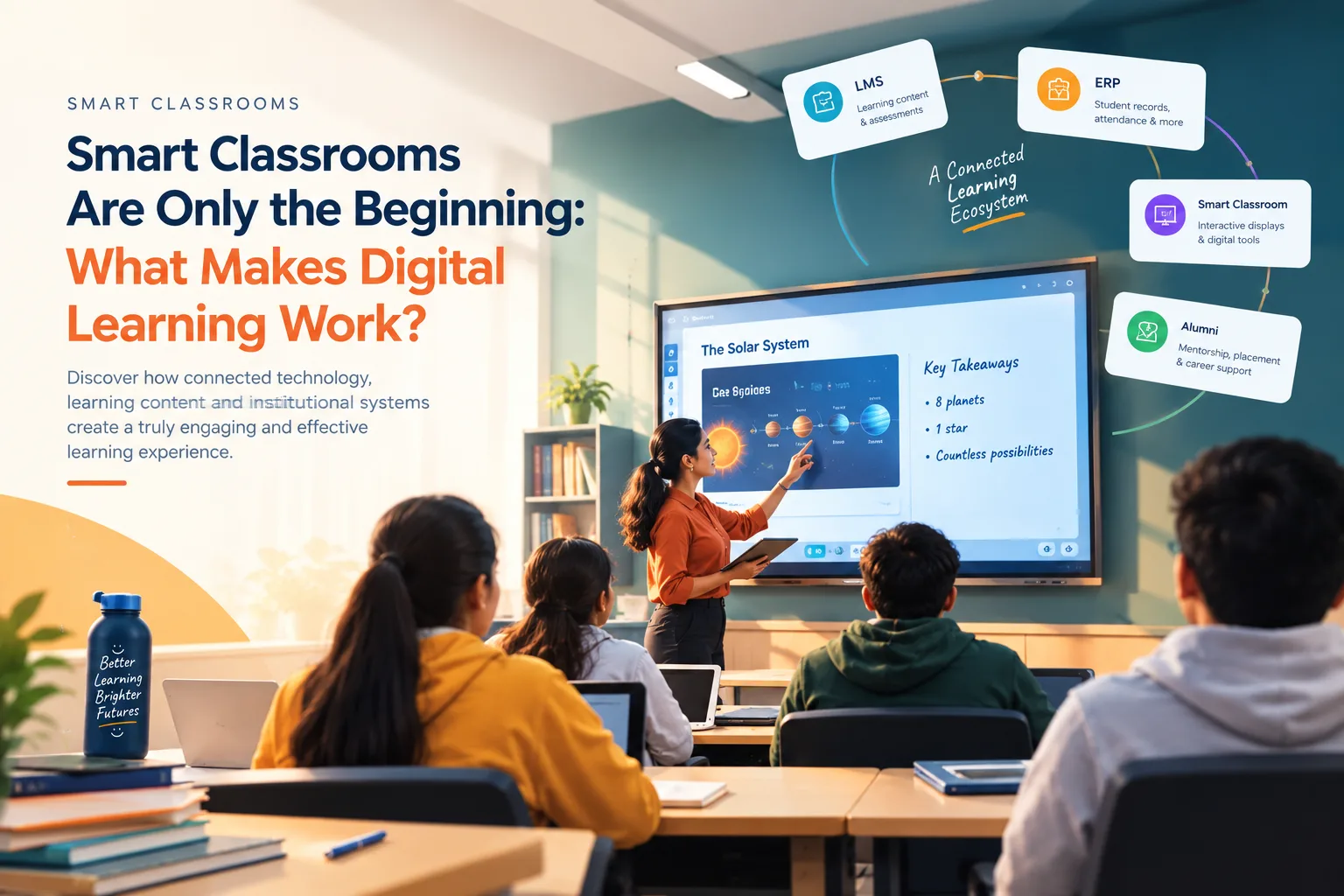
A classroom can have an interactive display, digital teaching materials and automated attendance, yet still leave teachers managing disconnected systems. Lesson plans may sit in one application, student attendance in another, and assignments or assessments in a separate learning platform. The technology is present, but the learning workflow remains fragmented.
This is the challenge modern smart classrooms need to solve. The real measure of classroom technology is not how advanced the equipment looks. It is how effectively it connects teaching, learning, participation and institutional data.
For schools, colleges and universities, the next stage of classroom modernization is therefore about building a connected learning environment. Interactive displays, digital content, virtual teaching and attendance tools become more valuable when they work alongside the institution's existing ERP and learning management systems. This integration can reduce repetitive work for faculty, create more consistent academic records and help institutions make better use of their technology investments.
What Makes a Classroom Truly Smart?
A digitally equipped classroom and a smart learning environment are not necessarily the same thing.
A projector or interactive panel can improve how a teacher presents information. However, a more connected classroom also considers how learning materials reach students, how classroom activities are recorded and how academic information moves into the institution's wider systems.
A practical smart classroom setup can include:
Interactive displays: Enable teachers to present multimedia content, annotate material and support classroom collaboration.
LMS-integrated content: Make lesson plans, presentations, videos and other learning resources available without repeatedly uploading the same files.
Attendance capture: Connect classroom attendance with the institution's existing attendance records.
Digital learning activities: Support discussions, assignments, quizzes and other activities that complement classroom teaching.
Connected academic records: Allow relevant classroom information to flow into the systems used by teachers and administrators.
The key distinction is integration. When classroom technology works with the institution's existing software, teachers can focus more on teaching and spend less time switching between applications or entering the same information more than once.
The Hidden Problem: Technology That Creates More Work
Institutions often evaluate classroom technology by comparing display specifications, connectivity options, equipment costs and installation requirements. These factors matter, but they do not reveal the full operational impact.
Consider a teacher who prepares a lesson in the institution's learning management system. If the same content must be uploaded separately to a classroom display, the teacher has to repeat the process. If attendance is captured by another tool but must later be entered into the ERP, administrative work increases again.
Across several classrooms and multiple academic sessions, these small tasks can become a recurring burden.
Disconnected systems can create four practical problems:
1. Duplicate data entry
Teachers or administrative staff may have to enter attendance, student details or learning activity information into multiple applications.
2. Inconsistent records
A student’s attendance or course information may differ between classroom tools, the LMS and the institutional ERP if updates are not synchronized.
3. Limited visibility
Academic coordinators may struggle to connect classroom activity with broader academic records when information is spread across separate systems.
4. Underused technology
Even capable classroom equipment can become an expensive presentation tool if it is not integrated into everyday academic workflows.
This is why smart classrooms should be evaluated as part of the institution's technology ecosystem, rather than as isolated hardware installations.
How LMS Integration Changes the Classroom Experience
A learning management system provides the academic structure around digital teaching. It can organize course materials, learning activities, assignments and assessments. When classroom technology connects with that system, digital resources become easier to use during teaching sessions.
For example, a teacher can prepare course material in advance and access it through the classroom display. Students can engage with the lesson, while relevant attendance and learning activities remain connected to the institution's wider academic workflow, depending on the systems and integrations enabled.
This approach can benefit different educational settings in distinct ways.
In schools
Teachers can use interactive content to explain concepts, demonstrate processes and support classroom participation. Board-aligned digital resources can complement conventional teaching, while an integrated LMS helps organize worksheets, videos and assignments for access beyond school hours.
In colleges
Faculty can combine presentations, demonstrations, discussions and digital learning resources. Connecting classroom activities with course and student records can also help reduce administrative duplication across departments.
In universities
Smart teaching environments can support lectures, seminars, demonstrations and blended learning. When connected to a university's academic systems, classroom activities can sit within a broader structure of courses, enrolments and attendance records.
The objective is not to replace the teacher or make every lesson dependent on technology. It is to make digital resources easier to access and academic processes more consistent.
Smart Classrooms and Virtual Classrooms: Different Roles, One Learning Journey
Smart classrooms and virtual classrooms solve related but different problems.
A smart classroom enhances teaching in a physical learning space through interactive displays, digital resources and connected classroom technology. A virtual classroom enables live teaching and interaction when participants join remotely. Depending on the institution's requirements, recorded sessions can also support revision and later access.
Neither approach needs to operate independently of the institution's LMS.
When the tools are connected, institutions can establish a more consistent learning journey across physical and remote sessions. Teachers can organize course resources through the LMS, conduct live sessions where required and keep relevant attendance or academic information connected to institutional records.
This is especially useful for institutions adopting blended learning, supporting students who cannot always attend in person or extending access to learning materials beyond scheduled classroom hours.
However, virtual access should not be confused with automatic learning effectiveness. Institutions still need suitable teaching methods, accessible content, reliable implementation and faculty support. Technology provides the infrastructure; thoughtful teaching determines how it is used.
Why ERP Integration Matters as Much as the Display
Classroom activities do not exist separately from institutional administration. Student enrolment, course allocation, attendance, timetables and academic records all influence how teaching is organized.
An ERP-integrated classroom environment helps connect these operational elements. For example, when class and student information is maintained in the relevant institutional system, connected applications can use that information instead of requiring separate manual setup, subject to the integration available.
This is where different ERP platforms have a role:
A school management system can connect classroom learning with student records, attendance and school-level administration.
A college management system can help coordinate academic activities around programmes, departments, batches and student records.
A university management system can support more complex academic structures, including multiple departments, programmes and campuses.
A campus management system can extend this connected approach across academic and administrative operations. Rather than treating classroom equipment as another independent application, institutions can assess how it fits into the systems they already use.
For schools, this may involve connecting classroom technology with a school ERP. Colleges may need integration with a college ERP, while universities may require the academic structure and institutional workflows supported by a university ERP.
The principle remains the same: relevant data should move through authorized systems with as little unnecessary repetition as possible.
Choosing the Right Learning Technology for Your Institution
Not every institution needs the same classroom configuration. A school with several sections and board-aligned lessons has different requirements from a university managing specialised laboratories, large lecture halls or multidisciplinary courses.
Before investing, decision-makers should assess the complete teaching workflow.
Start with existing systems. Identify the ERP, LMS and classroom equipment already in use. Determine whether the new setup can integrate with them before considering a complete replacement.
Define the teaching use case. Decide whether the priority is interactive lessons, digital demonstrations, live remote sessions, content access or a combination of these needs.
Evaluate the complete workflow. Check how lesson materials reach the display, how attendance is recorded and where relevant academic information is stored.
Consider faculty usability. Teachers should be able to use the setup without complex procedures or repeated technical intervention.
Plan for accessibility and continuity. Consider students' device access, connectivity limitations, alternative ways to access learning resources and the support required when technology is unavailable.
Review scalability. A pilot in a few classrooms can help an institution identify practical issues before expanding to more departments, campuses or branches.
These checks help institutions invest in technology that addresses actual teaching and operational needs rather than purchasing equipment based on specifications alone.
The Role of LMS Platforms in a Connected Classroom
The LMS is the academic layer that organizes course content and learning activities. Different LMS platforms for education offer different combinations of course delivery, assignments, assessments, reporting and integration capabilities. Institutions should evaluate these functions against their teaching model instead of selecting a platform solely on the number of features it advertises.
An lms education system can help faculty organize learning materials, manage digital activities and provide students with access to course resources. For schools, lms systems for schools may prioritize simple content sharing, assignments and parent visibility. Higher education institutions may need more extensive course structures, assessment workflows and academic outcome tracking.
Some institutions may also require a custom lms approach to support specialised teaching processes or integration requirements. Customization should solve a clearly defined need, not add complexity where existing functionality is sufficient.
The objective is to create a reliable connection between classroom delivery and the wider learning process. When the LMS, ERP and classroom technology work together, institutions can reduce duplicated effort and establish more consistent academic workflows.
How Sonet Connects Classroom Technology with Institutional Systems
Sonet Microsystems approaches smart classroom technology as part of a connected education environment. Its smart classroom offering focuses on interactive displays, LMS-integrated lesson content and attendance capture that connects with the institution's existing platform.
The setup is designed to work with Sonet's existing UniSCOP, ESCOP or eSSMS systems, rather than requiring an institution to replace its LMS simply to adopt classroom technology.
This creates a practical route to modernization:
For schools: eSSMS can support school-level administrative workflows, while classroom technology and LMS tools complement teaching and digital content delivery.
For colleges: ESCOP provides the college ERP foundation around which academic and administrative processes can be coordinated.
For universities: UniSCOP connects university-level academic and administrative operations, supporting a more unified institutional environment.
For digital learning: Sonet's LMS offering connects course delivery, assignments and assessments with relevant enrolment information from its ERP platforms.
The value of this approach lies in the relationship between systems. Institutions can assess classroom modernization alongside the software they already use, with the goal of improving continuity between teaching activities and academic administration.
Explore Sonet Smart Classrooms to understand the available setup and integration approach.
Measuring the Value of Smart Classroom Technology
A successful implementation should be evaluated through operational and teaching-related indicators, not just equipment installation.
Institutions can review:
Time teachers spend preparing and accessing digital lesson materials.
The number of manual steps required to record classroom attendance.
Frequency of duplicate data entry across connected applications.
Faculty adoption and the regular use of available classroom features.
Student access to digital learning materials and activities.
Reliability of information shared between the classroom setup, LMS and ERP.
Feedback from teachers, students and academic coordinators.
Establish a baseline before implementation and review the same indicators after deployment. This makes it easier to identify whether the technology is improving the intended workflows and where further training or integration work may be needed.
Results will vary according to the institution's starting point, teaching practices, infrastructure and implementation quality. A clear measurement plan helps keep modernization grounded in evidence rather than assumptions.
Conclusion: Move from Digital Classrooms to Connected Learning
The next step in classroom modernization is not simply adding more devices. It is connecting teaching resources, classroom participation and academic administration in a way that reduces friction for teachers and creates more consistent institutional processes.
Well-planned smart classrooms can support interactive teaching, digital content delivery and blended learning. Their wider value grows when they integrate with the LMS and ERP that already support the institution's academic operations.
For schools, colleges and universities, the priority should be a connected environment that fits existing workflows, supports faculty and can evolve with changing educational needs. By approaching classroom technology as part of a unified EdTech ecosystem, institutions can make more purposeful use of their digital investments.
Ready to assess your institution's classroom technology requirements?