A Modern Learning Management System Is No Longer Just a Digital Classroom
By Sonet Microsystems
Education has moved beyond simply putting lectures online. Today, institutions are expected to connect teaching, learning, assessment, academic administration, learner engagement, data, and emerging technologies within one coherent digital environment. That shift has changed the role of a learning management system from a course repository into a central layer of the modern education ecosystem. In other words, the learning management system is becoming part of the institution's core academic infrastructure.
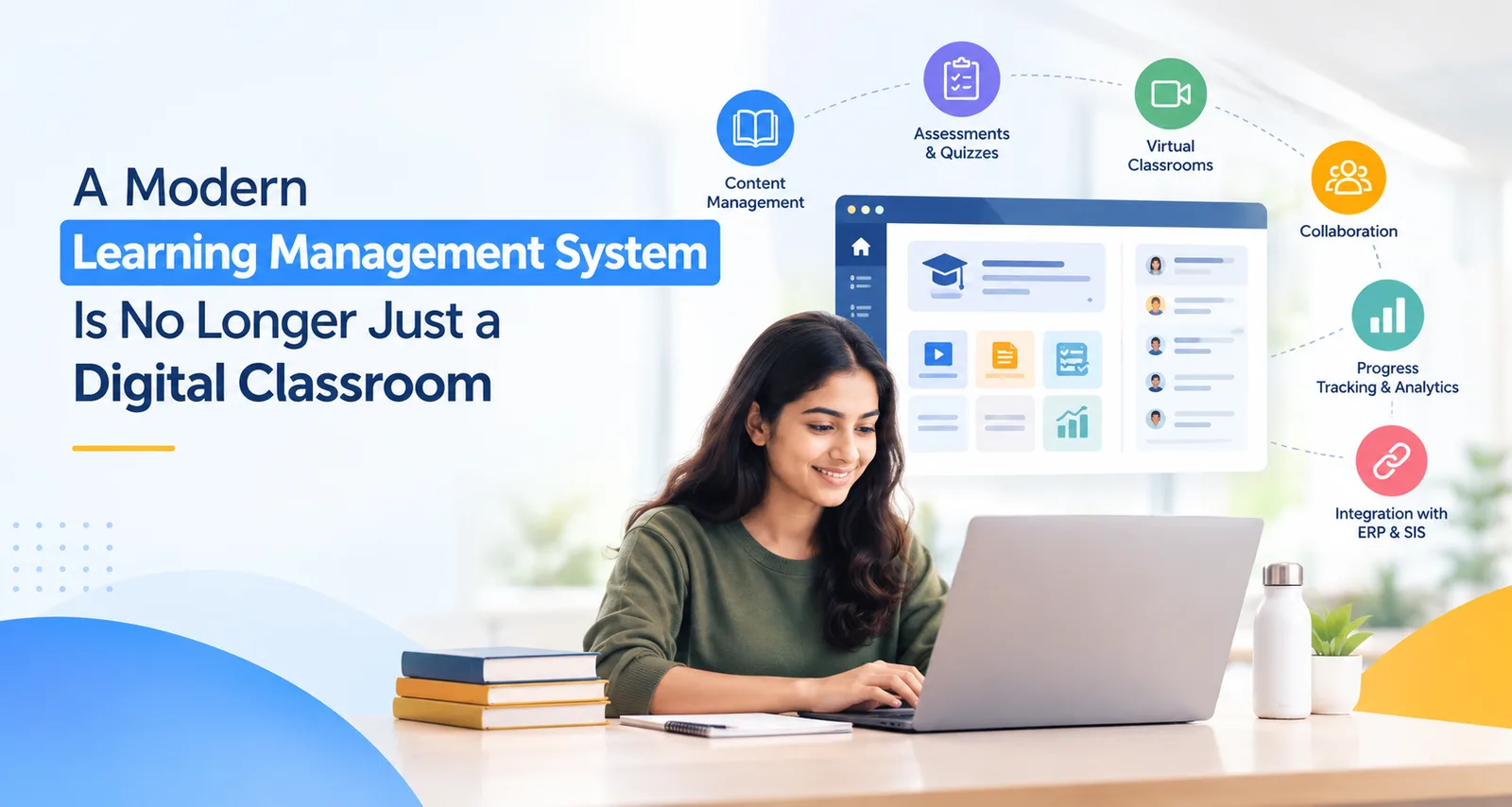
A contemporary learning management system can bring together course content, assignments, assessments, discussions, progress tracking, analytics, virtual classrooms, and learner support. A well-designed learning management system can make these capabilities available through a consistent experience for faculty, students, and academic administrators. For institutions, the bigger opportunity is integration: connecting these academic activities with ERP, SIS, attendance, examination, accreditation, and communication workflows so that information moves with the learner instead of being repeatedly entered across disconnected systems. UNESCO similarly describes an LMS as a web-based system supporting course delivery, administration, tracking, reporting, content creation, learner interaction, assessment, and grading.
What Is a Learning Management System?
A learning management system is a web-based digital environment that helps educators organise, deliver, assess, track, and report learning. In practical terms, a learning management system should support the complete cycle from planning a course to understanding what learners achieved.
The modern interpretation goes further. A learning management system should not merely store PDFs and videos. It should help institutions build structured learning journeys, give faculty practical tools to teach, provide students with continuous access to resources and feedback, and turn learning activity into useful academic intelligence.
This is where the difference between a basic LMS and a connected learning management platform becomes important.
Why Institutions Need More Than a Digital Content Repository
A fragmented digital environment creates familiar problems. Faculty may upload content in one system, conduct assessments in another, maintain attendance elsewhere, and rely on spreadsheets for performance reporting. Students then move between multiple interfaces, while administrators spend time reconciling information.
A modern learning management system addresses this fragmentation by creating a common academic workspace. The learning management system becomes the shared layer through which academic activities can be organised instead of remaining scattered across disconnected tools. Content, assignments, quizzes, discussions, examinations, progress data, and reporting can exist within one connected environment.
When the platform is integrated with an ERP or SIS, the value extends beyond the classroom. Student enrolment and course structures can flow into the LMS, reducing duplicate data entry. Sonet's LMS, for example, is designed to connect with UniSCOP, ESCOP, and eSSMS so that enrolment and relevant academic data can be synchronised across systems.
The result is not simply more software. It is a more continuous digital learning infrastructure.
Core Capabilities of a Modern LMS
1. Structured Course and Content Management
A strong learning environment begins with organised content. Faculty need to create courses, structure modules, publish learning resources, manage syllabus coverage, and provide students with content in a logical sequence.
Modern LMS environments can support videos, documents, readings, quizzes, assignments, discussions, and other digital resources. For higher education, structured course design can also support outcome-oriented learning and academic frameworks.
The learning management system therefore becomes the place where curriculum planning and day-to-day learning delivery meet.
2. Assignments, Quizzes and Digital Assessment
Assessment should be part of the learning cycle, not a separate activity. A modern learning management system enables institutions to create assignments, quizzes, question banks, objective assessments, and digital evaluation workflows. This makes the learning management system useful not only for delivering content but also for closing the feedback loop.
For higher education, Sonet's Knowledge Setu includes online quizzes, question banks, proctored examinations, automated objective grading, and digital workflows for subjective evaluation. It also brings plagiarism checking and assessment data into a connected academic workflow.
For schools, simpler workflows matter just as much. Teachers need to post worksheets, videos, homework, and tests quickly without turning routine academic tasks into administrative work.
3. Virtual Classrooms and Collaboration
Digital learning is not limited to recorded content. Live classes, discussion forums, messaging, breakout rooms, and collaborative activities can extend the classroom beyond physical boundaries. A learning management system can bring these experiences into the same academic journey instead of forcing learners to navigate unrelated tools.
For institutions running blended, online, or distance programmes, this continuity can be particularly important. Sonet's higher-education LMS supports live virtual classrooms, breakout-room-based interaction, conferencing, and asynchronous discussion forums.
4. Learner Progress and Performance Intelligence
One of the biggest advantages of digital learning is the ability to observe learning activity over time. A learning management system can turn those activity signals into progress views that help faculty understand where learners are engaging, completing, or struggling.
Instead of waiting until final examinations to understand performance, institutions can monitor course engagement, assignment completion, assessment results, and learner progress throughout the academic cycle. This creates opportunities for earlier academic intervention and more informed support.
For institutional leadership, dashboards can bring programme-level information together, turning scattered learning data into a more usable view of engagement, completion, and outcomes. Sonet's Knowledge Setu includes learner performance intelligence and institutional dashboards designed around these requirements.
5. AI-Powered Learning and Content Creation
Artificial intelligence is changing what an LMS can do.
The next generation of platforms can assist faculty with structured lesson creation, generate drafts, support video production, help learners navigate course material, and surface useful learning insights.
Sonet's higher-education LMS, Knowledge Setu, places AI within content creation, video generation, learner assistance, assessment, and institutional reporting rather than treating AI as a separate add-on.
The important principle is not using AI simply because it is available. The real value comes when AI reduces repetitive work and improves the learning workflow without taking the educator out of the process.
6. ERP and SIS Integration
An LMS becomes significantly more useful when it can communicate with the systems that already run an institution. When this connection is designed properly, the learning management system becomes a practical extension of the ERP rather than another isolated database.
ERP integration can connect enrolment, course structures, student records, and academic information with the learning environment. Sonet's LMS is built to sync with UniSCOP, ESCOP, and eSSMS, helping institutions avoid repeated student and course setup.
This connected approach can also support a smoother flow of information between academic delivery and institutional reporting.
7. Analytics, Reporting and Academic Intelligence
Modern education produces large volumes of learning data. The challenge is turning that data into something useful.
An advanced LMS can bring together activity, assessment, completion, and outcome information through dashboards and reports. In higher education, learning activity can also contribute to accreditation and quality reporting.
Knowledge Setu, for example, is designed to feed learning activity and outcome data into IQAC reporting and supports UGC's four-quadrant learning model: e-Tutorial, e-Content, Discussion Forum, and Assessment.
This moves the learning management system beyond basic course administration and toward an academic intelligence layer.
One Platform, Different Learning Environments
Not every institution teaches in the same way. A university, autonomous college, school, and ODL institution have different academic structures and user needs.
That means institutions should look beyond generic learning management system platforms for education and examine whether the system matches their actual teaching model.
For universities and colleges, the focus may include outcome-based education, course structures, assessments, plagiarism checking, proctored examinations, analytics, ERP integration, and accreditation reporting. This is where institutions evaluating the best LMS for university use should examine academic workflows rather than feature counts alone.
For K-12 institutions, usability is equally important. Teachers need fast assignment publishing, board-aligned content, simple class management, and parent visibility. Sonet's school-focused solution supports CBSE, ICSE, and state-board-aligned content mapping, quick assignment posting, parent visibility through app, SMS or WhatsApp, and class and section data synchronisation with eSSMS.
In both environments, the objective remains the same: make learning easier to deliver, easier to monitor, and easier to improve.
What Should Institutions Look for in LMS Software?
Choosing LMS Software should begin with academic requirements, not a long list of features.
Institutions can evaluate a platform across a few practical areas:
Content and course management
Assignment and assessment workflows
Virtual classroom and collaboration capabilities
Mobile and multi-device accessibility
Learner progress tracking
Analytics and reporting
AI-enabled academic assistance
ERP/SIS integration
Security and role-based access
Scalability across programmes, classes, or campuses
Support for the institution's academic and compliance requirements
The same evaluation applies whether the solution is delivered as a web-based LMS application, a broader learning management platform, or part of an integrated education technology ecosystem.
From LMS Software to a Connected Education Ecosystem
The future of digital learning is not about adding another application to an institution's technology stack. It is about making the existing stack work together. A connected learning management system can serve as the academic bridge between institutional records and everyday teaching activity.
A connected learning management system can sit between teaching and institutional systems, creating a continuous flow:
Student enrolment → Course allocation → Content delivery → Interaction → Assignment → Assessment → Performance analysis → Academic intervention → Reporting
This model reduces data silos and gives different stakeholders access to the information they actually need.
Teachers can focus on teaching. Students can access learning resources and feedback from one environment. Parents can gain visibility into school-level learning activities where appropriate. Administrators can reduce repetitive data entry. Academic leaders can use consolidated information for planning and review.
That is the difference between a standalone tool and a modern digital learning infrastructure. The learning management system becomes the connective tissue that keeps the academic experience coherent.
The Role of LMS in Higher Education
Higher education is becoming more flexible, outcome-oriented, and digitally connected. Universities and colleges increasingly need systems that can support regular, blended, online, and open and distance learning models.
For institutions searching for learning management systems for colleges, the evaluation should therefore extend beyond content delivery. Course outcomes, assessments, learner analytics, integration with academic systems, and reporting capabilities can be equally important.
A university-level LMS can also become part of the institution's broader academic intelligence layer. When learning data is connected with ERP and quality processes, information generated during everyday teaching can become useful for institutional reporting rather than requiring separate manual compilation.
Sonet's Knowledge Setu is designed for regular, ODL, and online universities as well as autonomous institutions and colleges, with UGC's four-quadrant model incorporated into the course structure.
For institutions considering an LMS for institute-wide deployment, scalability and integration are therefore as important as classroom features.
The Role of LMS in Schools
Schools have a different operational rhythm. Teachers manage multiple classes and subjects, students require age-appropriate learning resources, and parents often need visibility into academic activities.
This is why learning management software for schools must prioritise simplicity. A teacher should be able to share a worksheet, video, assignment, or test without navigating a complex administrative workflow.
A well-designed school LMS can support blended learning while keeping academic communication connected. When class, section, and student information comes from the school ERP, teachers do not need to maintain duplicate records.
Sonet's school LMS is designed around this approach, with board-aligned content mapping, rapid assignment posting, parent visibility, and ERP-synchronised class and section information.
The goal is not to make teachers become technology administrators. The goal is to make technology disappear into the teaching workflow.
How AI Is Redefining LMS Platforms
AI is moving the LMS from a system that records learning to a system that can increasingly understand learning patterns.
AI can assist with content creation, question generation, learner support, recommendations, performance analysis, and reporting. But institutions should evaluate these capabilities based on practical academic use cases.
An AI-enabled learning management system should help answer meaningful questions:
Which learners are falling behind?
Which concepts need reinforcement?
Which content is being used?
Where are assessment gaps appearing?
What repetitive academic tasks can be reduced?
Which reports can be generated from existing learning data?
This is where lms management system capabilities become more than administrative automation. They become part of an institution's decision-support environment.
Security, Accessibility and Scalability Matter
As more academic activity moves online, an LMS must also be dependable.
Institutions should consider role-based access, data protection, secure authentication, responsive design, cross-browser compatibility, infrastructure scalability, and usability across devices.
Sonet's higher-education LMS describes an architecture built for multi-device access, cross-browser compatibility, cloud readiness, and security practices aligned with OWASP principles.
For institutions serving large student populations or multiple campuses, scalability should be considered from the beginning rather than after adoption.
The Future: From Learning Platform to Academic Intelligence
The next phase of educational technology will be defined less by isolated tools and more by connected intelligence.
A modern learning management system can become the academic layer that connects content, people, assessments, data, AI, and institutional systems. When integrated properly, it creates a single digital environment where learning activity can inform teaching, academic support, administration, and institutional reporting.
This is particularly important as schools, colleges, universities, and online institutions move toward more flexible and technology-enabled models of education.
The future is not simply about putting education online. It is about creating an ecosystem in which technology supports the complete learning journey from course creation and content delivery to assessment, engagement, analytics, and continuous improvement.
For institutions evaluating lms platforms for education, the central question is therefore no longer only, “Can this platform deliver a course?”
It is:
“Can this platform connect the entire learning experience?”
A modern LMS should be able to bring that answer closer to yes through integrated learning, intelligent automation, meaningful analytics, and a technology foundation built around the way education actually works. Ultimately, the learning management system should make the digital learning journey more connected, measurable, and manageable.